
Sanctuary Cities: What Are They Really?
Since the term “sanctuary city” is a political term, not a legal one, it’s easy for anti-immigrant advocates to paint them as lawless. Given the confusion, we took a deep dive into what they do and don’t do, and what the data tells us about the results of these policies.
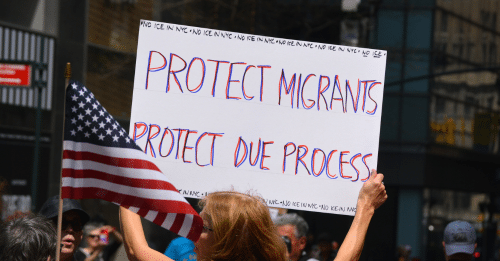
The term sanctuary city can be found all over the news, in political campaigns, and across angry social media threads. It’s often weaponized to conjure images of lawlessness and cities shielding “dangerous criminals” from justice. But behind the headlines and heated rhetoric, what is the truth? Sanctuary cities aren’t places where people can go to evade the law. These cities and states have committed to defend due process and other rights guaranteed to all people within the U.S., regardless of immigration status.
As the Trump administration intensifies its war on immigrants, pushing for mass deportations and attempting to achieve full cooperation from local police, it’s important to understand the role cities and states play in enforcing federal immigration law.
What is a Sanctuary City?
The term sanctuary city is a political label. It’s not legally defined, which makes it easy for commentators, politicians, and the everyday person to define the term in a way that best suits them. In practice, it describes jurisdictions, cities, counties, and even entire states that limit how much local police can collaborate with federal immigration enforcement. This means that if city leaders decide not to use local law enforcement resources to enforce federal immigration laws, the police department can choose not to hold someone in jail beyond their release date. This applies if the only reason for detention is a request from a federal immigration agency, and there is no judicial warrant or serious criminal conviction involved.
Pro-deportation advocates attempt to paint this as a form of protecting people who are possibly in the U.S. without proper documentation. That’s factually inaccurate. The Tenth Amendment of the U.S. Constitution states that the federal government can’t force local governments to carry out its agenda. Courts have repeatedly upheld this important principle, which is commonly referred to as “states’ rights.” A recent example of this is U.S. District Judge William Orrick’s ruling that blocked President Trump’s attempt to cut federal funding for sanctuary cities.
Despite this long-standing legal principle and orders from federal judges, the federal government continues to pressure and threaten to punish localities that won’t fall in line. Multiple executive orders have directed federal agencies to identify sanctuary jurisdictions and threatened to cut off federal grants and funding to those that don’t comply with federal immigration enforcement requests. These orders have also called for legal action against state and local officials accused of obstructing immigration law enforcement. So far, these attempts have been blocked or delayed by court injunctions and constitutional protections.
What Sanctuary Policies Actually Do for Real People (And What They Don’t Do)
While sanctuary policies don’t offer blanket protection from deportation, they do provide meaningful safeguards for immigrants who have documents and those who don’t. People who are suspected of not being native to the U.S. because of their skin color or physical appearance are also increasingly experiencing violations of various constitutional rights.
Generally speaking, sanctuary city policies tend to have these key characteristics:
- They limit ICE’s reach through local police: Sanctuary cities often prohibit local police from asking about immigration status or from detaining someone just because ICE requested it.
- They protect local budgets and priorities: Cities don’t have to spend their limited resources helping ICE do its job. That means more money and manpower go toward local public safety work.
- They build trust between immigrant communities and law enforcement: When immigrants don’t fear being referred to ICE, they’re far more likely to report crimes, cooperate with investigations, and call 911 for assistance.
But there are limits to these sanctuary city policies that are important to consider. Sanctuary cities:
- They don’t stop ICE from operating locally: Federal agents can still detain and deport people within sanctuary cities. Local policies just mean the city isn’t going to help with their enforcement work.
- They don’t hide or shield immigrants from the law: Local police still share arrest data and fingerprints with federal agencies. That information can and does trigger immigration enforcement should there be a legitimate reason for maintaining a hold on the person arrested.
- They don’t protect people from criminal prosecution: Not having legal immigration documents doesn’t shield anyone from investigations or arrest for other violations of local or state law.
So while sanctuary cities are often framed as lawless, the opposite is true. These policies help protect constitutional rights and abide by the important constitutional doctrine of states’ rights.
The Impact of Sanctuary City Policies
Since Trump’s second term began, ICE detainer requests have skyrocketed, with daily requests jumping by 72%, according to the latest report by Transactional Records Access Clearinghouse (TRAC). Despite that dramatic increase in ICE requests, only 14% of those requests led to ICE custody, and just 1.6% resulted in actual deportation. TRAC notes that “issuance of a detainer doesn’t automatically result in the person being taken into custody for a variety of reasons,” and that in sanctuary states and cities, local agencies often don’t honor ICE detainers unless there’s a judicial warrant or serious crime involved.
In places like California, Illinois, New York, and Colorado, states with strong sanctuary policies, most local agencies will only honor an ICE request if there’s a court order or a serious criminal conviction. Meanwhile, in states like Texas and Florida, where sanctuary policies are banned, local law enforcement routinely turn people over to ICE even for minor offenses such as minor traffic violations. As a result, these states have higher rates of transfer to ICE custody (e.g., Florida, 32%, and Texas, 12%) compared to sanctuary states.
Are Sanctuary Cities Safer?
Sanctuary policies have not been linked to an increase in crime. A 2017 study of U.S. cities found no statistical connection between sanctuary policies and higher crime rates. The study actually found the opposite to be true–these cities are actually safer, healthier, and economically stronger when compared across key variables. “Not only is increased immigration enforcement statistically ineffective in reducing crime, but collaboration between local law enforcement and federal agents actually worsens public safety, as it erodes trust between communities, local law enforcement, and public institutions,” stated Isobel Mohyeddin in a recent article about this topic from the National Immigration Law Center.
Sanctuary counties experience about 35 fewer crimes per 10,000 people than non-sanctuary counties, according to a 2017 study by Tom K. Wong, published by the Center for American Progress. In 2021, a congressional analysis found that counties adopting sanctuary policies experienced a statistically significant reduction in violent crime, especially robberies and assaults.
Sanctuary cities also have higher household incomes, lower poverty, and lower unemployment. An Oregon State University report showed that sanctuary counties have higher per capita incomes, higher median wages, increased employment, and lower unemployment rates compared to non-sanctuary or ICE-cooperating counties.
The Bottom Line
For immigrants, especially Latinos who are disproportionately targeted, sanctuary policies offer a measure of protection against being swept into deportation proceedings for minor infractions. They make it safer to report domestic violence, helping reduce domestic violence homicides among Latina women. They allow people to continue regular involvement with their family, friends, and community.
They also help keep family units together. Under ICE’s aggressive tactics, immigrant parents have been arrested at schools, churches, and hospitals–places that used to be off-limits. Sanctuary policies push back on the aggressive nature of these policies and help avoid chaos in environments where peace and calm are needed and expected.
The economic data is also compelling. Immigrants make up 14.3% of the population as of 2025, but contribute greatly to the U.S. GDP; $2.1 trillion in 2023, which accounted for 18.0% of total U.S. economic output. They also pay over $651 billion in taxes, with undocumented immigrants paying taxes at a higher rate than billionaires.
Working with ICE, on the other hand, costs local governments a substantial amount of money. A study from 2022 showed that collaborating with ICE costs communities upwards of $3.28 billion a year. In contrast, the NILC estimates that sanctuary policies have saved communities more than $100 million.
While sanctuary city policies continue to be attacked, the data shows that these policies produce good outcomes and are an important tool in helping to ensure the laws in the U.S. are applied fairly and as intended. Sanctuary cities aren’t at all what anti-immigrant advocates misinform the public to believe; they’re quite the opposite.
Authors


Related Articles

Understanding the Chaos: Inside the 2025 Immigration Enforcement Surge
With immigration arrests surging in 2025, confusion about law enforcement actions and what’s permissible is at an all-time high. We help clear the air.

The Latina-Led Women’s March That Confronted Fascism in 1937: A Lost Chapter of U.S. History
In 1937, 5,000 women marched through Tampa’s Ybor City to confront fascism in what would become one of the largest political demonstrations led by Latinas in U.S. history. Yet, few know about it.
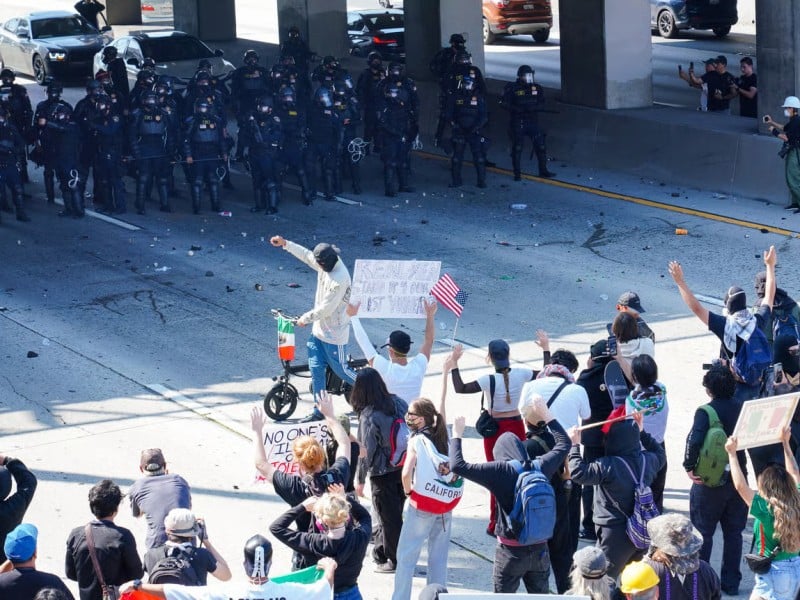
Smartphones are once again setting the agenda for justice as the Latino community documents ICE actions
In this article from The Conversation, Allissa V. Richardson explores the power of smartphone witnessing and Latino mobile journalists against state violence.