
The Psychological Cost of Crises—and Where to Find Help
We’re not built to live with chronic stress, but for many of us, that’s become the norm. We break down the effects of chronic stress and explore where to find real, culturally competent support when you need it most.
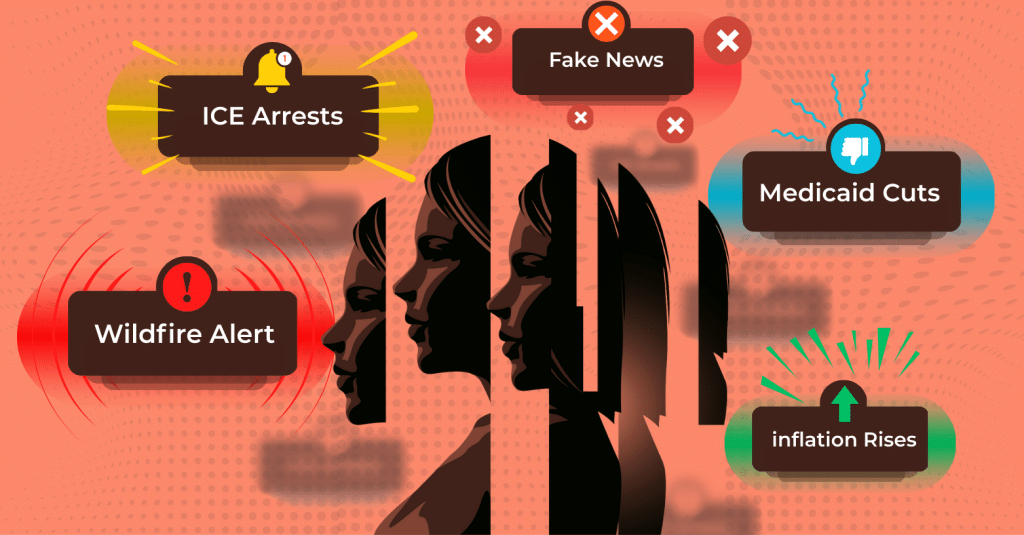
Both the United States and the world have continuously faced collective challenges and tragedy for a very long time, with some moments of respite. Experts have warned that humans aren’t built to endure chronic stress, which can lead to both mental and physical illness. Dr. Robert Sapolsky, neuroscientist, primatologist, author, and one of the world’s leading stress researchers, explains in his book “Why Zebras Don’t Get Ulcers,” that our stress response evolved for brief physical emergencies, noting that humans turn on the same stress response as zebras running for their life from a lion. The issue is we turn it on for purely psychological reasons, but that’s not what the stress response evolved for.
When we’re faced with a physical crisis, our stress response can be lifesaving. But if that stress response is constantly activated due to psychological stress, our health suffers. According to the Mayo Clinic, chronic stress can cause anxiety, depression, digestive problems, headaches, heart disease, sleep problems, memory and focus issues, and muscle tension and pain.
As the United States endures a time of heightened stress, brought on by stressors such as the future of the nation, which 77% of adults report as their main source of stress, immigration issues, financial strain, violence and crime, healthcare concerns, and more, communities needs resources to assist with getting through some pretty difficult times and crises that are too difficult to handle on one’s own.
Experts suggest these tools for coping with and reducing stress:
There’s no right or wrong way to feel
Everyone deals and reacts to trauma differently; whatever you’re feeling right now as a response to the issues that affect our communities is personal and completely valid. Don’t suppress your emotions; instead, find healthy coping mechanisms for them, like physical activity, meditation, yoga, journaling, etc. Those emotions can even be channeled into action like volunteering, spreading awareness and useful information, supporting organizations working towards change, and more.
If the news is starting to be too much, disconnect as much as possible
Awareness and staying informed are important, but when traumatic events occur or the news cycle is too much to bear, it’s easy to become overwhelmed with the constant flood of information and start to spiral. If you feel like constantly hearing what feels like a never-ending stream of bad news is starting to affect your mental and physical health, it’s not irresponsible to unplug for a bit to unburden your mind with other relaxing and de-stressing activities.
While it may be a privilege to be able to look away for a while from the issues that affect our communities, it’s also necessary to continue surviving and doing what we can to support one another. As Audre Lorde, Black lesbian feminist poet and activist, famously said, “Caring for myself is not self-indulgence, it is self-preservation, and that is an act of political warfare”.


Try to keep your usual routine going
Experts believe that one of the best ways to deal with trauma is getting back to your regular routine as much as possible. There is comfort in the familiar, so it can help minimize anxiety, traumatic stress, and hopelessness. It doesn’t mean acting as if nothing happened or nothing’s wrong; it just means trying to comfort yourself by not disrupting your life.
Reach out to others
Community is more important than ever now, and we’re all here to help each other. You may be able to find help in your loved ones or people close to you, but you can also reach out to people outside your network and connect more with your local community. What matters is that you share your feelings with others who may also understand what you’re going through.
“An ability to remain connected to (and invested in) community is one of the most important things during times of change, distress, disaster, or upheaval. It is through community that we find assistance for ourselves, that we are often able to find the motivation to set aside our own troubles to help others, and that we are able to begin the process of organized action and response,” stated Mary King, a writer and strategist for SaaS GovTech and Public Impact, in an article for the organization Engaging Local Government Leaders.
Seek professional help
Don’t be afraid to reach out if you assess that you can’t handle things on your own or with the help of your inner circle or community. Networks exist that can help you connect with a culturally competent mental health professional. We also recognize that Latinos disproportionately have less access to affordable support, but there are many resources that help fill in the gaps. Also, don’t let budget stop you; many of them are free to access. Check out these mental health networks:
- Psychology Today’s “Find a Therapist”. This directory makes it easy for people to find local mental health support. Simply enter your zip code or city, and it will provide a list of therapists in the area that you can contact for more information.
- National Queer and Trans Therapists of Color Network. This is another helpful directory that facilitates access to mental health for queer and trans Black, Indigenous, and People of Color.
- Latinx Therapy. This directory can help you find therapists in English and Spanish, and it offers free therapy to families affected by ICE raids and to Los Angeles wildfire survivors.
- Black Emotional and Mental Health Collective’s Black Virtual Wellness Directory. BEAM can help you find virtual Black therapists, doulas, yoga teachers, mediators, and more in your area.
- Don’t forget to check out your state health department. You may be able to find services close to you by contacting them, including emotional support helplines and self-help resources.
For more help finding mental health resources, call the NAMI HelpLine at 800-950-NAMI (6264) or text “NAMI” to 62640. In a crisis, call or text 988 for immediate support from the 988 Suicide & Crisis Lifeline. To reach the Crisis Text Line, text HOME to 741741 for 24/7 confidential support from a trained counselor.
Author

Related Articles

Breaking Free from the Scroll: A Practical Guide to Social Media Detox
Feeling drained by the scroll? Social media affects mental health more than we realize, often at a steep cost, and quitting cold turkey is easier said than done.

5 Misconceptions About Supplements: Setting the Record Straight
Think you know supplements? From “natural = safe” to “more is better,” there’s a lot of hype out there, and not all of it holds up.

The Thin Line Between Hard Work and Burnout
As Latinos, we’ve all been taught to hustle hard, but what happens when the grind takes over your health and happiness?