
Remembering Abraham Quintanilla, Selena’s Father & Patriarch of Tejano Music
Abraham Isaac Quintanilla Jr., the patriarch behind one of the most enduring legacies in Latin music history and the father of the late Tejano superstar Selena Quintanilla, died on December 13, 2025, in Corpus Christi, Texas. He was 86.
Originally published in Latina Media Co–reprinted with permission.
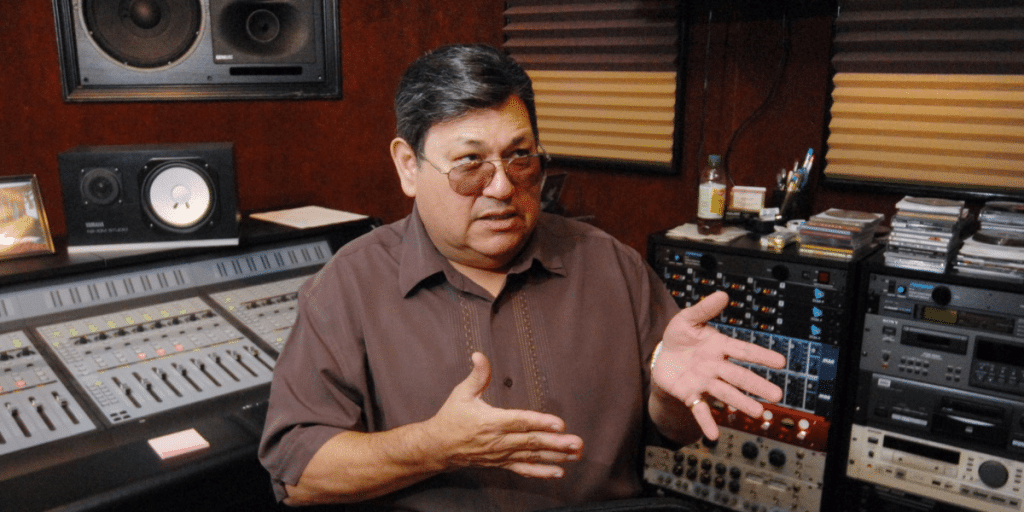
Abraham Isaac Quintanilla Jr., the patriarch behind one of the most enduring legacies in Latin music history and the father of the late Tejano superstar Selena Quintanilla, died on December 13, 2025, in Corpus Christi, Texas. He was 86.
Born on February 20, 1939, Quintanilla’s life unfolded alongside the slow and uneven rise of Mexican American visibility in U.S. popular culture. His story is inseparable from the history of Tejano music itself – an art form forged in borderlands, shaped by exclusion, and sustained by families who believed cultural survival could be achieved through sound. Long before Selena became a household name, Abraham Quintanilla was a working musician, performing with his band Los Dinos and confronting an industry that routinely dismissed Spanish-language music as marginal, regional, or commercially risky.
Those early years profoundly shaped Quintanilla’s worldview. As a young artist, he encountered racial, cultural, and economic barriers all at once. Tejano musicians were rarely afforded national radio play or industry investment, and success often depended on relentless touring, self-promotion, and community-based performance circuits. These realities informed the discipline, rigidity, and uncompromising standards Quintanilla later brought to managing his children’s careers – especially Selena’s, whose success would ultimately redefine the genre.
In the early 80s, after the family’s restaurant business collapsed during an economic downturn, Quintanilla made a decision that would change Latin music history: he transformed his children into a working band. Selena y Los Dinos was not merely a musical project but a family enterprise built on sacrifice, long nights on the road, and strict expectations. Abraham served simultaneously as manager, mentor, financier, and gatekeeper, guiding the band through quinceañeras, weddings, fairs, and small-town stages across Texas and the Southwest.
At the center of it all was Selena – whose voice, charisma, and bilingual acumen would propel her to unprecedented heights. Under her father’s management, she became the first woman to dominate the male-dominated Tejano charts, winning multiple Tejano Music Awards and, in 1994, a Grammy for Best Mexican-American Album. Her ascent was historic, not only for women but for Mexican Americans who had rarely seen themselves reflected in mainstream stardom without cultural dilution.
Media portrayals, public commentary, and fan discourse have long framed Abraham Quintanilla’s role in Selena’s rise as complex and polarizing. To supporters, he was a protector who shielded his daughter from an exploitative industry and demanded professionalism in spaces that routinely preyed on young artists. To critics, he was controlling, too involved in Selena’s career and personal life, and resistant to her growing independence. What remains indisputable is that his influence was foundational. Selena’s success did not emerge organically from industry benevolence. Abraham built it through structure, discipline, and family.
Everything changed on March 31, 1995, when Selena was murdered at the age of 23 by her former fan club manager Yolanda Saldívar. The loss devastated fans across generations and borders, crystallizing Selena as both an icon and a martyr. For Abraham Quintanilla, grief became public, permanent, and inseparable from responsibility. In the aftermath, he devoted his life to preserving Selena’s legacy, becoming its most visible and vocal steward.
He oversaw the establishment of the Selena Museum in Corpus Christi, managed her estate, and closely monitored the use of her image, music, and story. He played a decisive role in shaping how Selena would be remembered – not only as a cultural icon, but as a daughter whose life was violently cut short. He repeatedly appeared in interviews, commemorations, and legal disputes, where his involvement often ignited debates about ownership, memory, and control.
Film and television portrayals released after Selena’s death amplified these tensions. In the 1997 biopic Selena, filmmaker Gregory Nava portrayed Abraham – immortalized by Edward James Olmos – as stern, protective, and ultimately devoted. The film humanizes the patriarch’s rigidity while framing it as a necessary response to systemic exploitation. And it cemented a particular public image of the man as a hard-edged patriarch whose love manifested through control.
More recent portrayals, including Netflix’s Selena: The Series, reopened these debates for a new generation. While the series aimed for greater nuance, it reignited conversations about authorship, consent, and whose voice defines Selena’s story. In these portrayals, Abraham Quintanilla emerges as both guardian and obstacle — an embodiment of the complicated dynamics that arise when grief, legacy, and power converge.
Yet for many fans, especially within the Latinx community, Quintanilla’s vigilance ensured that Selena never became just a tragic footnote or commercial commodity. Through albums, tributes, fashion revivals, and biopics, Selena’s voice continues to live — and Abraham was central to that continuity, even when his methods deserved critique.
Beyond Selena, Abraham Quintanilla was also the father of A.B. Quintanilla III, a Grammy-winning producer and songwriter whose influence spans Latin pop and Tejano music, and Suzette Quintanilla, a former drummer for Selena y Los Dinos who later became a music executive and family spokesperson. His wife of more than six decades, Marcella Quintanilla, remained his partner through both the family’s triumphs and its deepest tragedies.
Abraham Quintanilla leaves behind a legacy that is both monumental and unresolved, a reflection of the realities faced by immigrant and working-class families navigating systems not designed for them. His life raises enduring questions about ambition and protection, grief and control, and who gets to author cultural memory. It also underscores the invisible labor behind the icons we celebrate, reminding us that success is often the product of family sacrifice as much as individual talent.
In shaping Selena’s career, Quintanilla helped expand the possibilities for Latin artists in the United States. He insisted that Tejano music mattered, that Spanish-language songs deserved space, and that Mexican American identity was not something to be softened for acceptance. Through his daughter’s voice, those convictions reached millions.
He is survived by his wife, two of his children, three grandchildren, and an immeasurable global community that continues to find itself in Selena’s music – and, by extension, in the legacy Abraham Quintanilla spent a lifetime protecting.
Author

Related Articles
10 Latino Myths to Get Spooked This Halloween
Even if you don’t totally buy into the supernatural, you have to admit—nothing beats the thrill of a good old-fashioned scary story.
September’s Latino Independence Days: A Month of Freedom
Across Latin America, September is a time of freedom, pride, and remembrance. This month marks the independence of many nations, each with its own powerful story of struggle, resilience, and celebration.
The Abuelita Blueprint: What Latina Grandmothers Teach Us About Life
We asked our readers what wisdom their grandmothers passed down, and the answers remind us just how much our abuelitas shape who we are.