
Latinos and the U.S. Economy: Deportations Threaten a $4.1 Trillion Powerhouse
Latinos are driving a powerful economic engine that keeps the U.S. moving forward, but mass deportations are putting that progress at risk.
Produced in partnership with Organized Power in Numbers.
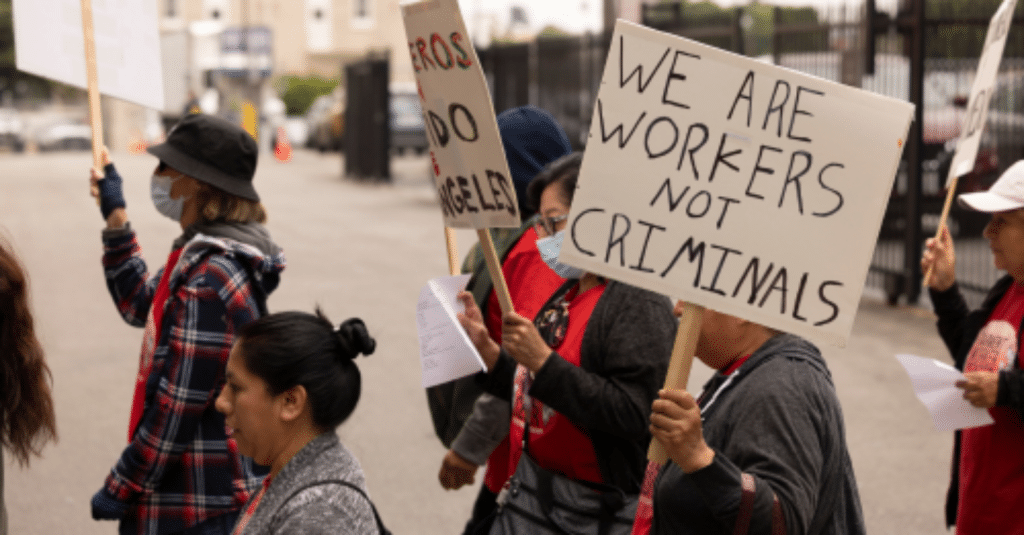
Each year, the Latino GDP Project publishes one of the most comprehensive looks at how Latinos drive the U.S. economy. Drawing on government data from the U.S. Bureau of Economic Analysis, Census Bureau, and Bureau of Labor Statistics, the report calculates the U.S. Latino Gross Domestic Product (GDP), a measure of the goods and services produced by Latinos in a given year.
Now in its eighth edition, the 2025 U.S. Latino GDP Report captures economic activity through 2023 and provides a striking picture: Latinos are not only a major force in the U.S. economy, they are its fastest-growing engine. At the same time, grassroots organizations like Organized Power in Numbers (OPIN) are sounding the alarm about the structural vulnerabilities facing workers, business owners, and entrepreneurs who are powering this growth. Through rights-based workplace trainings, immigration defense, community organizing, and large-scale mobilization efforts, OPIN is preparing workers to respond collectively to a policy environment that is increasingly destabilizing immigrant labor.
This year’s GDP report arrives amid profound uncertainty and an enforcement push that has already seen the Department of Homeland Security (DHS) announce that more than 2 million non-citizens from the U.S. “have been removed or have self-deported” between January 20 and September 23, 2025. This includes “an estimated 1.6 million who have voluntarily self-deported and more than 400,000 deportations” in under 250 days.
Scholars warn that mass deportations will lower U.S. GDP and reduce employment for workers overall through 2040. Moreover, mass deportations could have a ripple effect across industries from agriculture to construction, where the workforce is predominantly immigrant. Latinos are also prominent business owners and entrepreneurs, which compounds the ripple effect of deportations on the U.S. economy. As of 2025, there are over 5 million Latino-owned businesses in the country, making up 16.3% of all U.S. businesses. These businesses generated nearly $1 trillion in revenue and employed 3.8 million people in 2022.
Recent reports indicate growth rates of over 7% annually in Latino business ownership and, if current growth continues, the number of Latino-owned businesses is projected to reach over 9.5 million by 2032, representing more than 21% of all projected U.S. businesses. The progress Latinos have made over decades is now under threat, and the impact of mass deportations won’t be confined to sectors with high immigrant labor.
A $4.1 Trillion Powerhouse
In 2023, U.S. Latino GDP reached $4.1 trillion. If Latinos in the U.S. were their own nation, they would rank fifth in the world, larger than India, the United Kingdom, or France. Latino GDP has more than doubled since 2010, growing 2.7 times faster than non-Latino GDP.
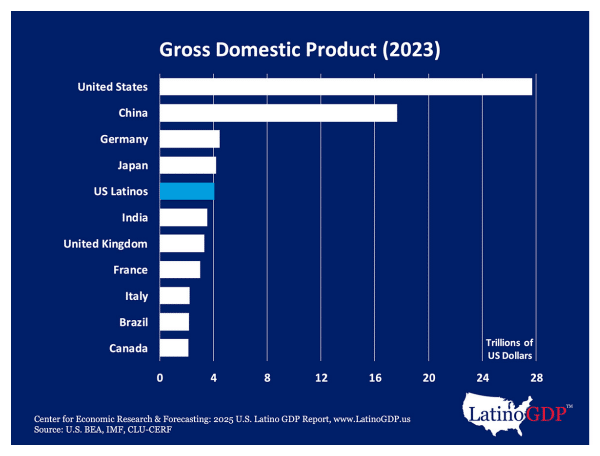
Latino consumption also reached $2.7 trillion in 2023, surpassing the economies of Italy and Brazil and growing 2.6 times faster than non-Latino consumption. From housing and childcare to food, technology, and transportation, Latinos are shaping demand across the economy.
The Economic Policy Institute warns that deporting 4 million people over four years could result in the loss of approximately 3.3 million jobs held by immigrants and 2.6 million jobs held by U.S.-born workers, with construction and childcare among the hardest hit. In California’s agricultural sector, for example, ICE raids have already led to a 20–40% drop in the workforce, $3–7 billion in crop losses, and food prices rising as much as 12%.
At the same time, corporate diversity, equity, and inclusion (DEI) programs are being scaled back. In 2025, references to DEI in Fortune 100 company reports dropped 72%, with firms like Walmart, Meta, and Constellation Brands cutting initiatives or rebranding efforts. The double hit of deportations removing workers and DEI rollbacks limiting corporate inclusion threatens both sides of Latino economic power: as laborers fueling industries and as consumers shaping markets.
Community Organizations Respond
As deportations rise, community organizations are stepping in to protect the workers who keep the U.S. economy running. One of the most active is Organized Power in Numbers (OPIN), a South- and Southwest-based organizing network that merges digital strategy with classic, on-the-ground community organizing.
OPIN’s flagship campaign, Workers Over Billionaires (WOB), is directly aligned with the economic reality of immigrant workers. The campaign’s objectives include: activating 10 million workers across the U.S., building from deep one-on-one conversations with family, neighbours, and coworkers; creating multiple pathways to action (for example, organizing at worksites, neighbourhood meetings, digital organizing); and launching bold, visible actions at scale so that the voice of workers can’t be ignored.
Immigration defense has become one of the most powerful components of the WOB campaign, and OPIN’s weekly immigration defense trainings have become a priority given the severe escalation in aggressive and legally questionable deportation tactics by the Trump administration. In 2025 alone, OPIN has conducted 24 defense training sessions for employers and neighborhoods, reaching 2,619 participants nationwide. Those participants then take what they’ve learned back to their own communities (mom-and-pop shops, swap meets, laundromats, markets, construction sites, apartment complexes, and more), equipping workers and small business owners with the knowledge to handle ICE encounters and raids.
The response has been overwhelmingly positive. Coalitions, worker centers, and political organizations nationwide, including Arizona, New Mexico, North Carolina, and California, have adopted OPIN’s materials and training model. And the model works. Alex Quintero, an OPIN organizer, shared in a virtual meeting with Luz Media one instance in Los Angeles in which OPIN visited a local shop and posted signage indicating restricted employee-only areas. A week later, ICE arrived. Because the employer and workers had been trained, they knew how to respond to assert their rights and successfully derailed the raid.
A Proactive Strategy for the Future and Engaged Volunteers
Beyond direct defense, OPIN is building cross-country alliances to strengthen worker protections long-term. As part of the Mayday Strong Coalition, OPIN regularly meets with labor unions and worker rights groups across the U.S. to share strategies, coordinate defense plans, and prepare for what enforcement may look like over the next several years. Staff have participated in multiple national convenings, including sessions hosted by the Chicago Teachers Union, to learn from parallel movements and align on proactive worker-driven strategies.
The WOB campaign has also sparked a wave of engaged volunteers. As an example, Quintero shared that one OPIN volunteer, a software engineer and father of triplets, created contestabien.com, an interactive bilingual website that helps users practice “know your rights” scripts in English and Spanish. The tool includes audio features for users who cannot or prefer not to read, making essential information accessible to everyone, and quizzes at beginner, intermediate, and advanced levels to help people rehearse what to say in real federal enforcement encounters.

According to Quintero, those who learn their rights through OPIN’s trainings are inspired to take action. In 2025, 1,054 attendees have participated in the Workers Over Billionaires Monthly Mass Call events that help sustain momentum around major mobilizations like May Day, Labor Day, and No Kings rallies. And many others have joined OPIN’s Signal chat networks to coordinate local defense teams, deepen political education, build worker power, and create political homes for people seeking community.
A Nation Built by Workers Cannot Afford to Lose Them
The data in the Latino GDP Report makes one message clear: the U.S. depends on Latino workers, consumers, and entrepreneurs for its economic vitality. Protecting that strength requires protecting the people who generate it. At a moment when deportations and aggressive policy changes threaten decades of progress, sustained worker power is essential not just for immigrant communities, but for the nation’s economic future.
Author

Related Articles

Latino Heritage Month: 30 Micro-Actions to Make a Big Impact
Latino Heritage Month, observed from September 15 to October 15, is a celebration that can be turned into impact through small yet intentional, everyday choices.

9/11 Changed Everything and Its Echoes Are Louder Under Trump’s America
The legacy of 9/11 has shaped the way we travel, the surveillance we accept, and the policies we live under. And much of this legacy has been compounded by policy changes under the Trump administration.

Labor Day: Thankless Jobs, the Wealth Gap, and Annual Mattress Sales
We explore what late-stage capitalism has done to Labor Day and the people who labor.