
San Antonio’s 2026 Midterm Election: What to Know Before You Vote
San Antonio, the 2026 midterm election is coming up! Learn key dates, what’s on the ballot, and what to check before heading to the polls.

On Tuesday, November 3, Bexar County voters will help decide who represents Texas in the U.S. Senate and U.S. House, who leads the state as governor, who serves in the Texas Legislature, and who holds key positions in Bexar County government.
The ballot you see will depend on where you live, especially for congressional and state legislative races. Because Texas redrew its congressional districts in 2025, many San Antonio-area voters may be voting in a different congressional district than they did in 2024.
Whether this is your first election or you already have your polling routine down, here’s what San Antonio voters need to know before November.
First, Save These Election Dates
The March primaries and May runoffs are over, so most candidates on the November ballot have already been decided.
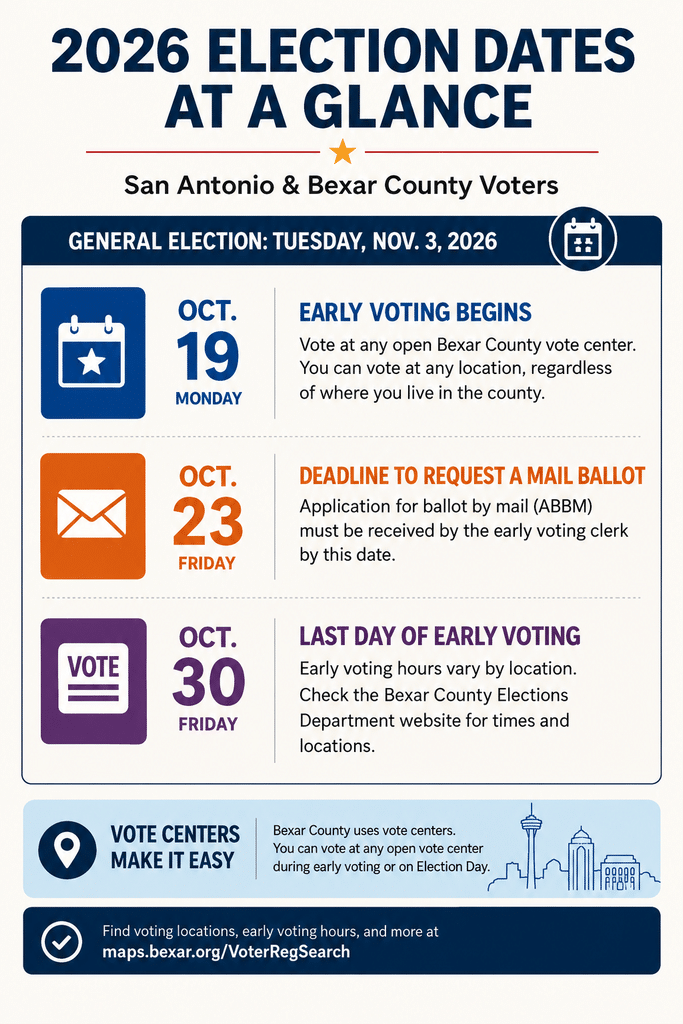
For the November 3 general election, these are the dates to remember:
- October 19: Early voting begins
- October 23: Deadline for eligible voters to submit an Application for Ballot by Mail; the application must be received by the early voting clerk by this date
- October 30: Last day of early voting
Polls are open from 7 a.m. to 7 p.m. on Election Day.
What’s Actually on the Ballot?
Midterm elections happen halfway through a presidential term. The president isn’t on the ballot, but voters elect members of Congress along with state and local officials.
In Texas, 2026 is a full election year. All 38 Texas seats in the U.S. House, one U.S. Senate seat, the governor’s office, other statewide executive offices, and many judicial offices are up for election.
Voters will also decide 16 of the 31 Texas Senate seats and all 150 Texas House seats.
That means a San Antonio ballot can include races stretching from Washington, D.C., all the way down to the Bexar County Courthouse.
Your Congressional District May Have Changed
San Antonio voters should pay particular attention to this part of the ballot.
Texas redrew its congressional map in 2025, and Bexar County is now divided among Congressional Districts 20, 21, 23, and 35.
Depending on where you live, your congressional race could include:
- District 20: Democrat Joaquin Castro and Republican Edgardo Baez
- District 21: Republican Mark Teixeira and Democrat Kristin Hook
- District 23: Republican Brandon Herrera, Democrat Katy Padilla Stout, and independent Ben Mendoza
- District 35: Republican Carlos De La Cruz and Democrat Johnny Garcia
Don’t assume your congressional district is the same one you voted in during 2024. Bexar County’s voter lookup tool can show your current districts and sample-ballot information based on your registration.
Bexar County Has Major Races, Too
Two of the most prominent countywide contests are for Bexar County judge and district attorney.
The Bexar County judge presides over Commissioners Court and is one of the county’s most influential elected officials. Commissioners Court makes key decisions involving the county budget, infrastructure, public health, courts, public safety, and other county services.
Former San Antonio Mayor Ron Nirenberg, the Democratic nominee, faces Republican Patrick Von Dohlen.
Voters will also elect a new district attorney after incumbent Joe Gonzales decided not to seek reelection. Democrat Luz Elena Chapa, Republican Ashley Foster, and independent Jason Wolff are running.
Depending on their address, some voters may also see local propositions on the ballot, including a measure related to extending Pre-K 4 SA funding. Check your address-specific sample ballot for the exact wording and to see which propositions apply to you.
Before You Vote, Check These Three Things
1. Check your status
The registration deadline was October 5. If you were registered by then, check your status, especially if you recently moved or changed your name, to confirm that your voter information and voting districts are current.
2. Find a voting location
Bexar County uses vote centers, so registered voters can cast a ballot at any open county vote center rather than being limited to one assigned neighborhood precinct.
That flexibility applies during early voting and on Election Day.
Locations can change between elections, so check Bexar County’s current list before heading out rather than relying on where you voted last time.
3. Know what ID you can bring
Texas accepts seven forms of photo ID for in-person voting:
- Texas driver’s license
- Texas Election Identification Certificate
- Texas personal identification card
- Texas handgun license
- U.S. military ID with a photo
- U.S. citizenship certificate with a photo
- U.S. passport book or card
For voters ages 18 to 69, an accepted ID can generally be expired for up to four years. Voters 70 and older can use any valid accepted ID regardless of how long it has been expired.
If you don’t have one of those IDs and cannot reasonably obtain one, you may still be able to vote using an approved supporting document and a Reasonable Impediment Declaration.
Planning to Vote by Mail?

Texas doesn’t offer no-excuse voting by mail to every voter.
You may qualify if you are 65 or older on Election Day, are sick or disabled, expect to give birth within three weeks before or after Election Day, will be outside your county throughout early voting and on Election Day, are confined in jail but otherwise eligible to vote, or meet certain involuntary civil-commitment requirements.
For the November 3 election, Bexar County must receive your Application for Ballot by Mail by October 23. A postmark by that date isn’t enough.
Mail voters must provide identifying information on both the application and ballot carrier envelope: generally a Texas driver’s license, personal ID card, or election identification certificate number; or, if they have not been issued one of those numbers, the last four digits of their Social Security number.
On the carrier envelope, voters who have been issued neither may state that fact in the designated space. Missing or mismatched information can result in the application or ballot being flagged for review, though voters who receive a defect notice may have an opportunity to correct it.
Completed mail ballots generally must be received by the early voting clerk by 7 p.m. on Election Day. A ballot mailed from within the U.S. and postmarked by 7 p.m. on Election Day may still be counted if it arrives by 5 p.m. the following day, provided it meets the state’s requirements.
Do You Have to Vote for the Party You Chose in the Primary?
No.
Texas doesn’t register voters by political party. Participating in a party’s primary can affect which runoff you can vote in during that same primary cycle, but it doesn’t lock you into that party for the November general election.
In November, voters can choose candidates from different parties across their ballot.
Check Your Ballot Before You Go
With races stretching from the U.S. Senate to county courts, there’s a good chance your ballot will include candidates and offices that received little attention during campaign season.
Your exact ballot depends on your address.
The Bexar County voter lookup tool lets voters check their registration and current districts and access voting and sample-ballot information.
For statewide rules, deadlines, voter ID requirements, and vote-by-mail information, check VoteTexas.gov and the Texas Secretary of State.
Nonpartisan resources, including VOTE411, also provide ballot and candidate information, while the San Antonio Report’s 2026 Voter Guide includes profiles and explainers on San Antonio and Bexar County races.
The most useful thing you can do before heading to the polls is simple: check your registration, look at your sample ballot, and confirm where you plan to vote.
Author

Related Articles

Texas Voter Suspense List Explained: What San Antonio Voters Need to Know
Checked your voter registration and saw “Suspense” next to your name? Don’t panic! Here’s what you need to know.

A Step-by-Step Voter Registration Guide for Bexar County Ahead of November
Planning to vote in San Antonio this November? Don’t wait until Election Day to make sure you’re ready.

Everything Voters Need to Know About the May 26 Runoff Election
Several races across San Antonio and Bexar County are headed to the May 26 runoff election, and we explore what voters should know before heading to the polls.