
Floods Send Anti-Immigrant Buoys to Laredo, Shutting Down World Trade Bridge
More than 100 anti-immigrant border buoys broke loose during Rio Grande flooding last week, drifting roughly 125 miles downstream before forcing the temporary closure of part of Laredo’s World Trade Bridge, the busiest land port on the U.S.-Mexico border.
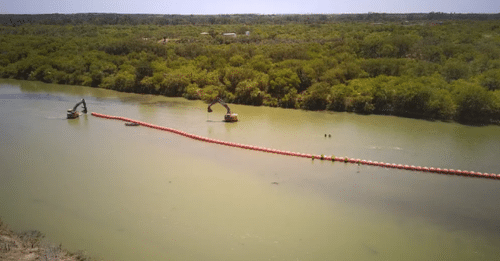
More than 100 federal border buoys broke loose in the flooded Rio Grande last week, floating some 125 miles downstream and forcing a temporary shutdown of part of Laredo’s World Trade Bridge, the busiest land port on the U.S.-Mexico border.
What Happened
Heavy rains caused the Rio Grande to flood at Eagle Pass on July 16. The rising water swept away roughly 100 to 120 large cylindrical buoys, each weighing about a ton and 12 to 15 feet in length, that hadn’t been installed yet at Eagle Pass’s Shelby Park.
The buoys are part of U.S. Customs and Border Protection’s “Operation River Wall,” also called the “smart wall,” a federal plan to install more than 500 miles of waterborne barrier along the Rio Grande intended to deter illegal crossings. A Maryland‑based contractor, Gibraltar Construction Company, had been staging hundreds of the buoys at the park ahead of installation.
On July 7, the Eagle Pass City Council voted against the company’s request to lease park land for the staging area, and the city told Gibraltar to remove the buoys; according to Amérika García Grewal of Frontera Federation, the company hadn’t done so when the flooding began.
The loose buoys forced Eagle Pass to temporarily close its two international bridges as a precaution. “The bridges are the number one funding source for the city, so it is very detrimental,” City Manager Homero Balderas told the Texas Tribune. No injuries or structural damage were reported.
While some reporting on social media has incorrectly identified the drifting buoys as part of Gov. Greg Abbott’s 2023 Operation Lone Star barrier, Abbott’s office stated that the floating cylinders that broke loose were part of the federal project, not the state’s barrier.
Border Report, citing a local official, reported that part of the state’s original buoy barrier also became dislodged after being struck by the larger federal buoys.
The Trip to Laredo
The buoys drifted miles downstream to Laredo, where Mayor Victor Treviño declared a local disaster on July 17 for its 260,000 residents.
Some buoys became lodged at the base of the World Trade Bridge, and the city suspended commercial traffic over the weekend of July 19–20 as a precaution, while a federal contractor removed them; Treviño said there was no structural damage to the bridge, and traffic was expected to resume once the removal was complete and floodwaters receded.
The World Trade Bridge normally carries about 15,000 to 20,000 commercial trucks per day and handles close to $1 billion in cross‑border trade daily; the broader Laredo customs district is the nation’s top port by trade value, processing around $3.5 billion in goods each week.
U.S. Customs and Border Protection (CBP) told reporters it wasn’t responsible for the escaped buoys because it hadn’t yet formally taken possession of them from the contractor.
The Warnings
A study commissioned in March 2026 by the Rio Grande International Study Center and presented to the Laredo City Council warned that buoy barriers could dislodge during major floods and threaten downstream communities and infrastructure. Fluvial geomorphologist Mark Tompkins, who authored the report, identified that scenario as a potential risk.
Frontera Federation had separately raised concerns about the buoys since they first arrived at Shelby Park in June, arguing they were installed without environmental review or flood modeling. The group stated in a press release that DHS waived more than 30 federal laws, including the National Environmental Policy Act and the Endangered Species Act, to accelerate the estimated $3 billion project.
Federal contractors have removed the buoys that became lodged at Laredo’s World Trade Bridge, and commercial traffic has resumed. The incident has intensified questions about Operation River Wall, but reporting indicates the administration is still moving ahead with the project.
Author

Related Articles
San Antonio Lawmakers Renew Calls to Close Dilley Family Detention Center
San Antonio Congressman Joaquin Castro is once again calling for the closure of the Dilley Family Detention Center after touring the facility for the seventh time.

Restore TECH Academy Opens San Antonio’s First Adult Charter High School
This fall, San Antonio will welcome its first tuition-free public charter high school for adults, giving Texans ages 18 to 50 a new pathway to complete their education.

FBI Warns San Antonio Parents About Online Networks Targeting Children
The FBI warns San Antonio families about online networks that target children. Here’s what parents should know to help keep kids safe.