
How the Aztec Theatre Survived 100 Years of Reinvention
For nearly 100 years, the Aztec Theatre has welcomed generations of San Antonians through its doors. Here’s how it has survived.
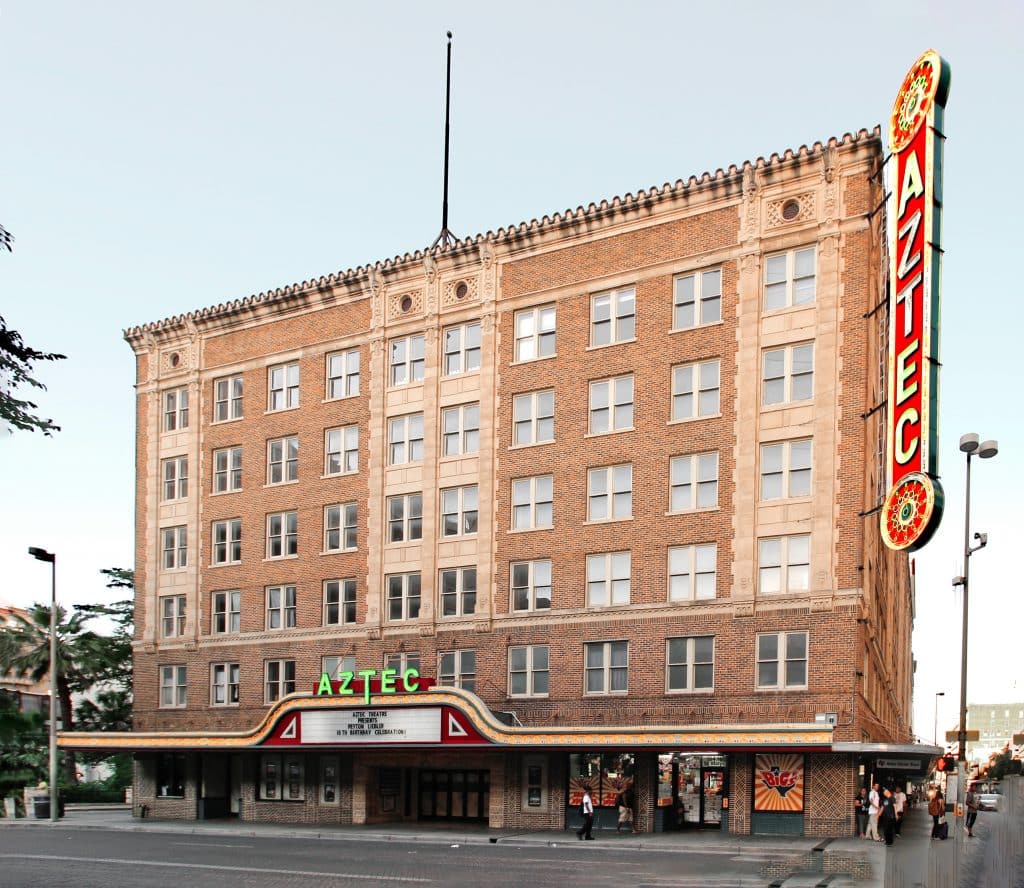
.jpg)
When the Aztec Theatre opened its doors on June 4, 1926, downtown San Antonio looked very different.
The River Walk hadn’t yet become the city’s defining attraction, movies were still silent, air conditioning was a luxury, and going to the theater felt like stepping into another world for a few hours.
A century later, audiences still gather under the Aztec’s towering columns for concerts, stand‑up comedy, and other live performances instead of silent films.
In a city that has changed dramatically over the last hundred years, the Aztec Theatre has managed to evolve without losing what made it special in the first place, and that’s a rare accomplishment.
Built to Be an Experience
Created by the architectural firm Meyer & Holler, best known for designing Hollywood’s Egyptian and Chinese Theatres, the building embraced the “atmospheric theatre” movement that swept the country during the 1920s. These movie palaces were conceived as destinations designed to transport audiences before the film even began.
Inside, visitors found elaborate columns, colorful murals, sculptures, carved masks, and decorative elements inspired by Aztec, Maya, Mixtec, Toltec, and Zapotec cultures. It quickly became one of downtown’s architectural landmarks and is recognized as a rare surviving example of Mesoamerican‑inspired theater design in the country.
Its lobby is still dominated by a massive two-ton chandelier installed in 1929, reportedly the largest in Texas at the time. Today, it continues to greet visitors walking through the front doors.
The Art of Reinvention
Like many grand movie palaces, the Aztec eventually faced an uncertain future.
Television changed entertainment habits, and multiplex cinemas drew audiences toward the suburbs. By the 1970s, the theater had been divided into three smaller auditoriums to remain competitive, operating as the Aztec Triplex. It wasn’t enough. After decades of declining attendance, the theater closed in 1989.
For many historic theaters across the country, that would have been the end of the story. Instead, preservation efforts saved the Aztec from demolition; it was then added to the National Register of Historic Places in 1992, recognizing both its architectural significance and its place in San Antonio’s cultural history.
The years that followed became a period of experimentation. Restoration efforts in the late 1990s and early 2000s gave the building new life, first through Aztec on the River, an immersive multimedia attraction celebrating the theater’s history and Mesoamerican-inspired design, and later through San Antonio Rose Live, a resident stage production that introduced live entertainment to the historic venue.
Its biggest transformation came in 2013, when new ownership reconfigured the auditorium into a flexible event space while carefully preserving its distinctive interior. Two years later, Live Nation took over operations, establishing the Aztec as one of downtown San Antonio’s premier venues for concerts, comedy, podcasts, and special events.
More Than Nostalgia
Today, the Aztec hosts everything from rock concerts and stand-up comedy to Latin music, drag performances, podcasts, and private events. It also continues evolving. This summer, the building is entering a new chapter with the opening of the 77-room Aztec Hotel, which occupies the theater’s former upper-floor office spaces and will operate as part of Marriott’s Tribute Portfolio.
As reported by the San Antonio Report, this new chapter will also include Zenita, a rooftop restaurant and bar serving Asian-Latin fusion cuisine with views of downtown and direct access to the River Walk, as well as the Alamo IceBar in the theater’s basement, where visitors can enjoy drinks inside a room made entirely of ice and maintained at 13 degrees.
The audiences filling the Aztec today look very different from the ones who packed its 3,000 seats in 1926, but the building still serves the same purpose: bringing people together for a shared experience.
Author

Related Articles
Why September 16 Matters in San Antonio: The History of Mexican Independence Day
Every September, San Antonio fills with Mexican flags, mariachi, and parades. We explore the history behind September 16.
Myth vs. Reality: What People Get Wrong About San Antonio
Some San Antonio “facts” have been repeated so often that nobody really questions them anymore. So, we did.

Chicken on a Stick: San Antonio’s Signature Bite and Where to Try It
What started as a Fiesta San Antonio favorite has become a year-round craving, with local restaurants putting their own spin on the crispy classic.