
San Antonio’s People’s Hearing on Immigration Enforcement Put Local Stories at the Center of a National Conversation
We break down the issues that shaped the conversation at the People’s Hearing on Immigration Enforcement in San Antonio and what happens next.
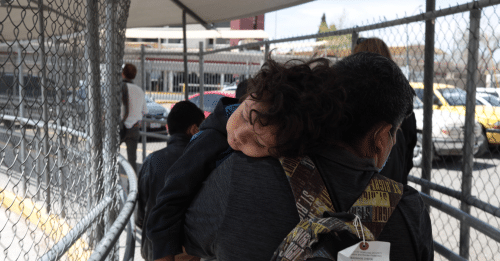
Immigration enforcement has become one of the defining issues in San Antonio this year, sparking conversations at City Hall, in neighborhoods, and across the state.
On Tuesday, those conversations took center stage at the People’s Hearing on Immigration Enforcement: San Antonio, a public forum that brought together elected officials, including Mayor Gina Ortiz Jones, civil rights leaders, legal experts, and people directly affected by immigration enforcement to document how federal policies are impacting communities.
Unlike a legislative hearing or court proceeding, the conference was designed to create a public record of firsthand experiences that organizers say can inform future oversight and accountability efforts.
What Is the People’s Hearing on Immigration Enforcement?
Held at Sueltenfuss Library at Our Lady of the Lake University, the hearing is part of a national series organized by the Texas Civil Rights Project, Hispanic Federation, Latino Victory Foundation, and the Miranda Family Fund, alongside local community organizations.
San Antonio was the fourth stop in the series, following hearings in St. Paul, Minnesota, Chicago, and Los Angeles. “This is not political,” Texas Civil Rights Project President Rochelle Garza told Texas Public Radio (TPR) ahead of the event. “This is about ensuring accountability and ensuring that the truth is documented.”
Garza, who also serves as chair of the U.S. Commission on Civil Rights, moderated the hearing alongside former commission chairs Marty Castro and Norma Cantú.
What Was Discussed?
The hearing focused on how expanded federal immigration enforcement is affecting individuals, families, and communities.
Throughout the morning, organizers heard testimony from people who have experienced immigration detention, as well as attorneys, advocates, and community members working with immigrant families.
The discussion centered on several recurring themes:
- Conditions inside immigration detention facilities.
- The impact of detention on children and families.
- Cooperation between local law enforcement and federal immigration agencies.
- The use of surveillance technology, including license plate readers.
- Allegations of racial profiling.
- Use-of-force incidents involving federal immigration agents.
- The economic effects on neighborhoods and small businesses when fear of enforcement discourages people from going to work, shopping, or attending community events.
The hearing opened with remarks from Our Lady of the Lake University President Abel Antonio Chávez, Mayor Jones, and Latino Community Foundation CEO Julián Castro.
In his opening remarks, Castro stated, “We’re here because we’re witnessing a national crisis of cruelty that is being propagated by our federal government against some of the most vulnerable people in our nation.”
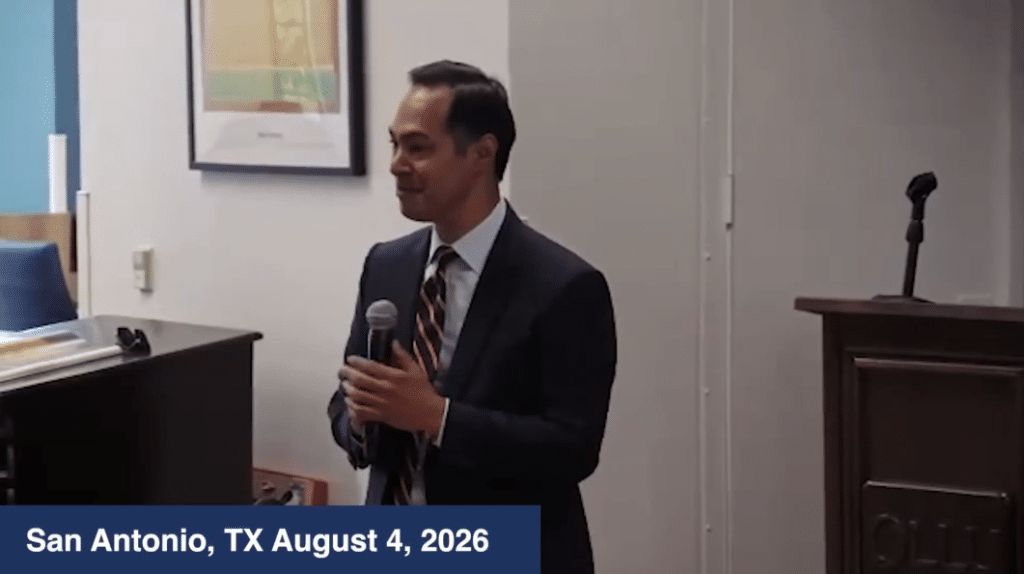
“In the face of an administration that is absolutely determined to punish immigrants in this country, whether they, quote, ‘did it the right way or not,’ in the face of a congress that is controlled by people who are happy to look the other way at this cruelty, and [in the face] of courts that have been too slow to respond and to stop them, it is the people that must rise up […] [and] do everything that they can to stop it. In order to do that, it is necessary first that we hear the truth,” he said.
The Issues Driving the Hearing
Over the past year, San Antonio has become one of the state’s most closely watched immigration enforcement jurisdictions
In recent months alone:
- ICE has recorded nearly 1,500 arrests in the San Antonio region, according to KSAT.
- Members of Congress toured the Dilley Family Residential Center in July, later calling for its closure after raising concerns about conditions inside.
- The detention of Churchill High School student Emely Charloth Suaza Chambo and her father drew widespread attention after they were arrested by ICE while traveling to church. They have recently been released.
- City leaders have continued opposing plans to convert an East Side warehouse into a large federal immigration processing center.
These developments have been the driving force behind the hearings and provided much of the backdrop for the discussions in San Antonio, which you can watch in full on the Hispanic Federation website.
Another reason for organizing the hearings is to document concerns surrounding several fatal encounters involving federal immigration agents. Garza specifically referenced four deaths that illustrate broader civil rights concerns:
- Renée Good and Alex Pretti in Minnesota.
- Lorenzo Salgado Araujo in Houston.
- Ruben Ray Martinez, the San Antonio native and U.S. citizen who was fatally shot by federal agents on South Padre Island in March 2025.
Martinez’s death has drawn particular attention in San Antonio after investigations found that ICE’s involvement in the shooting wasn’t publicly disclosed until nearly a year later.
What’s next?
According to the hearing’s organizers, the testimony gathered in San Antonio will become part of a public record documenting how immigration enforcement is affecting communities across the country. Like previous stops in Minnesota, Chicago, and Los Angeles, the coalition is expected to publish a report summarizing the testimony and findings from the San Antonio hearing in the coming months.
For now, the hearing offered something organizers say is often missing from conversations about immigration enforcement: a space for people directly affected by those policies to share their experiences alongside legal experts, elected officials, and civil rights advocates.
Author

Related Articles
San Antonio Lawmakers Renew Calls to Close Dilley Family Detention Center
San Antonio Congressman Joaquin Castro is once again calling for the closure of the Dilley Family Detention Center after touring the facility for the seventh time.

Restore TECH Academy Opens San Antonio’s First Adult Charter High School
This fall, San Antonio will welcome its first tuition-free public charter high school for adults, giving Texans ages 18 to 50 a new pathway to complete their education.

FBI Warns San Antonio Parents About Online Networks Targeting Children
The FBI warns San Antonio families about online networks that target children. Here’s what parents should know to help keep kids safe.